
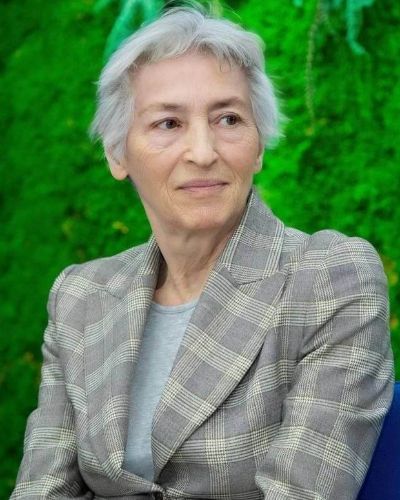
Professor
Institute of Nuclear Physics of Uzbekistan Academy of Sciences, Uzbekistan
Abstract:
Background: Interest in selenides increased in 2000 because of a new phenomenon discovery - structure phase transition induced by irradiation of metal-chalcogenide glass with focused 10-15 keV electron beam in SEM. Kinetic Monte Carlo simulations of fcc clusters showed that particles with six neighbours move faster below the roughening temperature. Recently As2Se3 and other metal chalcogenides have been attributed to a new class of photonic semiconductors due to their unique set of properties, such as low electrical conductivity, strong optical nonlinearity, high photosensitivity. Anion isovalent doping (S,Se,Te) generates shallow hole centers thereby combining high optical absorption, exciton luminescence and hole conductivity.
Methods: Our research is aimed at growing nanocrystal arrays under scanning fast electron beam and studying how the induced nanostructures influence the optical extinction (absorption and reflection). Material: As2(Se,S)3 film deposited on the poly(ethylene terephthalate) has the width 3 cm and thickness 55 µm. The U-003 linear electron accelerator with the parameters: 5 MeV electron beam at current density - 400 nA/cm2, current pulse – 4 µs, beam width – 3 cm, beam scan 30 cm. Samples were irradiated in air at 160 and 290 K within fluency range 1014-1015 cm-2 (6 dose steps). The following methods were implemented: SPM for surface roughness and morphology, SEM-EDS for quantitative local chemical element composition, XRD for crystal structure and phase composition analysis, FTIR and UV-vis spectroscopy.
Results: The estimated fast electron energy transfer is 104-105 J/cm2. Since the maximal shell electron energy of As and Se is 12 keV, the scattering mechanisms are ineffective. The dominating mechanisms are ionization and radiation losses on the way of 5 MeV electron to the As and Se nuclei followed by nuclear reactions: As(33,42) + e- = Ge(32, 42)* seconds-living radionuclide; Se(34,46) + e- = As(33, 46)* minutes-living radionuclide. The both radionuclides emit beta and gamma producing structure damages. SPM revealed nanoscale grating (1-3 nm stripe height, 10-20 nm step) in the pristine sample. The electron fluency 1014 cm-2 at 165 K results in smoothening of sharp peaks of the grating and transforming it into larger cones. The dose dependence of optical density at Eg looks like periodic charging-discharging. And at 290 K one can see the distance between the neighboring fast electrons ~ 80 nm for the given electron beam density 400 nA/cm2. The beam is inhomogeneous and makes stripes of conical and rod-like nanocrystals along the beam scanning direction. It happens with the significant contribution from the thermal diffusion at 290 K, as compared to that at 160 K. Semimetal Arsenic cations are driven by the strong electric field towards the electron tracks as suggested by [Yoshida-1997].
Conclusions: The scanning 5 MeV electron beam at moderate fluencies and low temperatures resulted in the fast growth of Asn and As2Se3 rod-like (up to 100 nm height) faceted nanocrystal stripes arranged along the beam scanning direction on the exposed film surface. Such an ordered morphology intensified the fine structure of the optical oscillations. The process of self-assembling nanoparticles in faceted nanocrystals is driven by the known law of minimizing entropy.
Biography:
Prof. Ibragimova Elvira Memetovna is a material scientist specializing in researches of nuclear radiation impact on chemical element composition and crystal structure transformations in solids at macro-micro-nano-scales, and also physical functional response of various dielectric, semiconducting and superconducting materials on the irradiation. She holds Diploma of PhD, DrSci, Senior Scientist, Professor in physics of condensed state from the Institute of Nuclear Physics, Uzbekistan Academy of Sciences and has published ~100 research articles in international journals. She is currently a Principal Researcher in this Institute and the chair of Expert Council in Physics in Uzbekistan.
© 2026 Mathews International LLC. All rights reserved.
