

Abstract:
Introduction: This study investigates the real-time monitoring of PDMS polymerization using the molecular rotor (MR) farnesyl-(2-carboxy-2-cyanovinyl)-julolidine (FCVJ) [1]. MRs offer a cost-effective, non-invasive method for tracking polymerization dynamics by correlating fluorescence emission with viscosity changes [2]. Unlike conventional methods, MRs provide real-time data without the need for bulky instrumentation, offering significant advantages for process optimization [3]. This research aims to extend MR-based monitoring to a broader range of polymers, enabling precise control over material properties in industrial and biomedical applications.
Results and Discussion: We conducted a comparative analysis of the rheometer measurements against the fluorescent emission of FCVJ at temperatures of 100°C and 60°C, as illustrated in Figure 1. At 100°C, the emission curve demonstrates a remarkable 70% increase within the initial 20 minutes of the reaction. Significantly, approximately 10 minutes post-initiation, the polymer exhibits a transition from elastic to viscoelastic behavior, suggesting the attainment of the gel point. In contrast, the polymerization process at 60°C proceeds at a markedly slower rate, extending up to five times longer to achieve completion compared to the reaction at 100°C. The findings indicate that the gel point is reached around 25 minutes after the reaction commences, during which a fluorescence increase of 40% is already evident. The initial phase of the reaction can be effectively modeled using the Förster-Hoffman equation (1), applicable during the stage when the material demonstrates fully viscous behavior.
log(I_f )∝xlog(η)+C (1)
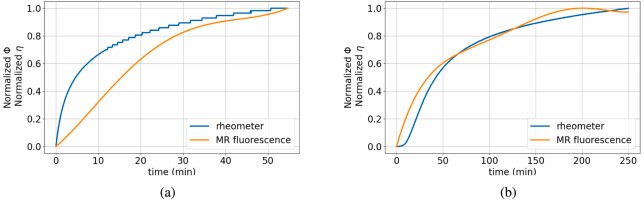
Figure 1: Comparison of normalized values of rheometric measurements and MRs fluorescent emission at 100°C (a) and 60°C (b).
Conclusions: The paper presents a new technique for monitoring the polymerization behavior of PDMS using fluorescent quantum yield analysis at different temperatures. It reveals a strong dependence on curing temperature and the importance of environmental temperature conditions in interpreting viscosity assessments.
Biography:
Flavia Di Scala is a biomedical engineer specializing in sensor engineering and advanced fluorescent materilas. She holds a MSc in Engineering from Politecnico di Milano and she is currently pursuing her PhD at Maastricht University in the Sensor Engineering Department. Her research focuses primarily on the study of the fluorescent properties of molecular rotors to sensor viscosity, from a tool to monitor polymerization to a diagnostic method for infectious diseases.
© 2026 Mathews International LLC. All rights reserved.
