
Title : Dual memory characteristics and lattice reaction governing reversibility in shape memory alloys
Abstract:
Shape memory alloys are adaptive structural materials and take place in a class of advanced smart materials by exhibiting dual memory characteristics, shape memory effect and superelasticity, with recoverability of two shapes in different conditions. Shape memory effect is initiated with thermomechanical processes on cooling and deformation and performed thermally on heating and cooling, with which shape of the material cycles between original and deformed shapes in reversible way, and this behavior can be called thermoelasticity. This is plastic deformation, due to soft character of material in low temperature condition, with which strain energy is stored in the material and releases on heating by recovering original shape. Shape memory effect is governed by thermomechanical transformations, thermal and stress induced martensitic transformations. Thermal induced martensitic transformation occurs on cooling with cooperative movement of atoms in <110 > -type directions on {110} – type close packed planes of austenite matrix, along with lattice twinning and ordered parent phase structures turn into the twinned martensite structures. Moreover, twinned structures turn into detwinned martensite structures by means of stress induced martensitic transformations with deformation in the low temperature conditions. Superelasticity is performed with stressing and releasing the material in elasticity limit at a constant temperature in the parent austenite phase region, and shape recovery occurs immediately upon releasing, by exhibiting elastic material behavior. Superelasticity is also result of stress induced martensitic transformation, and the ordered parent phase structures turn into the detwinned martensite structures with stressing. It is important that thermoelasticity is result of thermoresponsive reaction, and superelasticity is result of mechanical responsive reaction. Twinning and detwinning reactions play important role in martensitic transformations and they are driven by internal and external forces by means of inhomogeneous lattice invariant shears.
Copper based alloys exhibit this property in metastable β-phase region, which has bcc-based structures. Lattice twinning is not uniform in these alloys, and the ordered parent phase structures undergo the non-conventional layered structures with martensitic transformation. These layered structures can be described by different unit cells as 3R, 9R or 18R depending on the stacking sequences on the close-packed planes of the ordered lattice.
In the present contribution, x-ray and electron diffraction studies were carried out on ternary copper based CuZnAl and CuAlMn alloys. X-ray diffraction profiles and electron diffraction patterns exhibit super lattice reflections. Critical transformation temperatures of these alloys are over the room temperature. X-ray diffractograms taken in a long-time interval show that locations and intensities of diffraction peaks change with the aging time at room temperature, and this result refers to the redistribution of atoms in diffusive manner.
Biography:
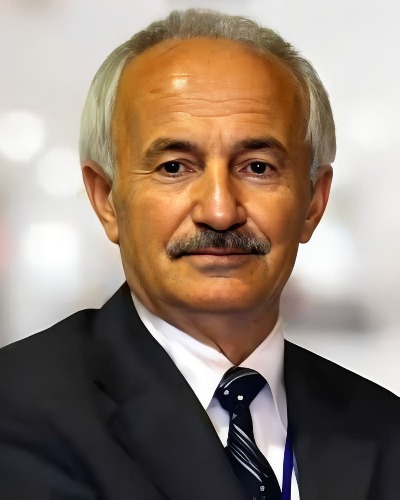
Dr. Adiguzel graduated from Department of Physics, Ankara University, Turkey in 1974 and received PhD- degree from Dicle University, Diyarbakir-Turkey. He has studied at Surrey University, Guildford, UK, as a post-doctoral research scientist in 1986-1987, and studied on shape memory alloys. He worked as research assistant, 1975-80, at Dicle University and shifted to Firat University, Elazig, Turkey in 1980. He became professor in 1996, and he has been retired on November 28, 2019, due to the age limit of 67, following academic life of 45 years. He published over 80 papers in international and national journals; He joined over 120 conferences and symposia in international and national level as participant, invited speaker or keynote speaker with contributions of oral or poster. He served the program chair or conference chair/co-chair in some of these activities. In particular, he joined in last six years (2014 - 2019) over 60 conferences as Keynote Speaker and Conference Co-Chair organized by different companies. Also, he joined over 180 online conferences in the same way in pandemic period of 2020-2023. He supervised 5 PhD- theses and 3 M. Sc- theses. Dr. Adiguzel served his directorate of Graduate School of Natural and Applied Sciences, Firat University, in 1999-2004. He received a certificate awarded to him and his experimental group in recognition of significant contribution of 2 patterns to the Powder Diffraction File – Release 2000. The ICDD (International Centre for Diffraction Data) also appreciates cooperation of his group and interest in Powder Diffraction File.
© 2026 Mathews International LLC. All rights reserved.
